Pages

Showing posts with label ramadan. Show all posts

Saturday, January 28, 2012

Jaj bil Firn/ Oven baked Chicken

Hey guys, well i know it has been a very very very....very long time since I last posted and I am truly sorry for those of you that care. I hope to finally keep up even though I added a new hobby to my daily life ( I've become obsessed with crocheting blankets for the past couple of months). Anyways this is an easy dinner recipe that is hard to screw up. I love this dish so much because of the lemon and garlic and when those two ingredients are together you can't go wrong. Anyways this is how I make it.


Start of by smashing a lot of garlic, since it will be cooked you don't have to worry about a a stinky mouth afterwards :). I used half a garlic bulb (or around 7 or 8 good sized garlic cloves).
Next I squeeze lemon juice directly on top of the garlic. This help cook the garlic a little. If you smashed your garlic with salt then you should be fine but if not add some salt in at this point.
I find that since this sauce cooks in the oven and reduces that you need to either add some water or some chicken broth. I add water (since the chicken will produce its own juices) so that the chicken and veggies don't come out too sour.
Wash and dry the chicken very well. Here I am using a whole chicken cut in half. Some people use chicken thighs or chicken drumsticks or even a whole chicken cut up into 8 pieces (2 thighs, 2 drumsticks, 2 wings, and 2 breasts). I find that by leaving the chicken whole it keeps the breast more moist because it is covered by the skin and the skin doesn't move and uncover the breast while cooking.
Place the chicken in the desired over safe pan. I am using my biggest pyrex dish here. Sprinkle with salt and pepper and just a little but of olive oil to get the chicken started. Side note: When i buy chicken make sure to cut off the last digit of the wing and to cut off the "butt" of the chicken. There isn't anything extremely wrong with leaving them on but I get a little grossed out by those parts.
Cook the chicken in the over at 500 degrees until the chicken skin has dripped off some of the fat. The chicken is not cooked at this point. I then drain the fat in the pan or soak it up with paper towels. There is not juice at this point only fat because we cooked it at such a high temperature.
Next add in the wedged potatoes and baby carrots (the original recipe only has potatoes but sometimes i also add koosa (squash) and purple onions). Lay the veggies around the chicken but dont cover the chicken with the veggies. Pour the lemon/garlic/olive oil sauce on the veggies (but not on top of the chicken) and then tent some foil over top. When I say tent the foil I mean to lightly cover it but don't make it air tight.
Continue to cook the chicken until it is cooked all the way and the veggies are soft. When it comes out of the oven let it rest for about 20 minutes so that the veggies and chicken can soak up the lemony goodness. Right before I serve it I take a spoon and i pour the thickened sauce on top of the chicken and veggies.
TA DAH..perfection. The skin is crispy (for those of you that eat the skin...I just peel it off) and the potatoes and carrots have so much flavor.
The chicken should be really really moist. This is a picture of the breast which usually is the most dry part of the chicken and you can tell how moist and tender it comes out in this dish (thanks to the skin).

Written Recipe:

1 whole chicken cut in half with skin on
1/2 smashed garlic bulb (7 to 8 garlic cloves)
juice of 2 lemons (or 3/4 cup)
1/4 cup of chicken broth or water
olive oil (use your desired amount but I recommend about 1/4 cup or less)
salt and pepper to taste
2 to 3 potatoes peeled and cut into 8 wedges each
baby carrots (optional)
other optional veggies: Koosa (squash) and purple onions

Cook the chicken for about 30 minutes uncovered at 500 degrees to cook off some of the fat and then drain the fat and add the veggies and the sauce. Cook for another 45 minutes to an hour or until the chicken is fully cooked and the veggies are soft and tender (400 degrees).

Thursday, September 8, 2011

Kabseh

Kabseh is like a rice dish that every Arab country has. Every country has their own form of kabseh and every household makes their kabseh a little different. I believe that kabseh originated from the khaleej (Saudi Arabian area) because I know they are known for their kabseh and mendhi. Like I said earlier, everyone has their own way of making kabseh, some people use mixed spices that are labeled kabseh spices, some people make their own spice mix, some people add veggies, come people make it with meat and not chicken. You cannot mess this dish up, just do whatever you want, this is how I make kabseh at home.


In a pan (same one I will be cooking my rice in) I add some oil and then I add onion and carrots that were chopped in a food processor (I use to cut it all by hand but it is the same thing) and then once the water is gone that comes out of the onion and carrot I add tomato paste and cook it until the oil separates a little and the oil has an orange color. Then I add the spices, I use kabseh spice (I will tell you the mix later if you can't find it), cardamom, cloves, nutmeg, cinnamon and salt and paper. Set this aside and make the salsa that is eaten on the side with the kabseh.
Side note: I use to add fresh tomatoes but the rice sometimes would come out soggy or dry because it is hard to estimate how much water will come out of the tomatoes and how much water you need to add to the rice so tomato paste is what I use now.
Oh so Kabseh can be eaten with yogurt or salad or nothing....OR you can make this salsa like sauce that is eaten on the side. This sauce reminds me of the sauce that we use to eat with the rice from the Mendhi that my aunt would buy whenever we went to Bouqain (It was made by khaleeji restaurant). Anyways, if you haven't tried this before, it is really good so I suggest you make it at least once.
So I chop the tomatoes a little just to get them going then I add cilantro, garlic, a little bit of onion, a fresh jalapeno (or some cayenne pepper if you don't have a jalapeno on hand) and salt.
At the end I add a squeeze of lemon juice.
Place it in the fridge and let the flavors mix (the garlic and jalapeno flavors will come out more so don't add more garlic and jalapeno at this point until you let it sit for at least 30 minutes)
This is my rice cup, I use it to measure everything (even though I have measuring cups, it keeps me feeling like I am cooking Syrian food properly). I measured the amount of rice in my cup so I could write it on this blog and it is exactly 1 cup.
Wash the rice and add it to the carrot, onion, tomato paste and spice mix.
This is optional but most people do add it. I add raisins (not the black ones), just soak them for about 10 minutes and add them to the rice along with the chicken stock. (I cook chicken the same way I have in previous posts so I didn't show how here)
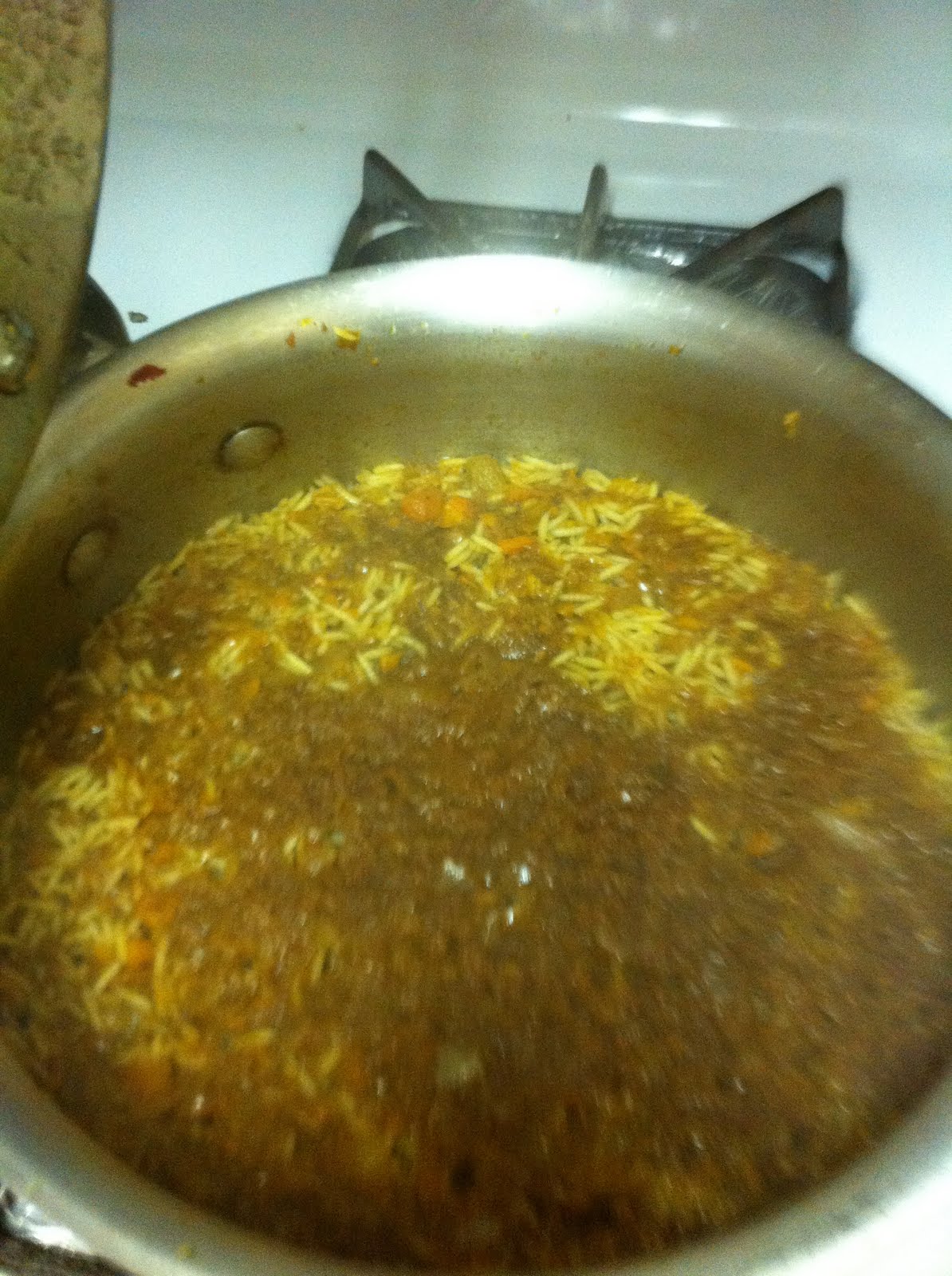
Add the chicken stock and cook on medium until the water is level with the rice then cover the pot and turn the heat down to the lowest setting for about 10 or 15 minutes or until the rice is cooked all the way through.
Arabs love to add nuts to their dishes so you can add any kind you want, these are my favorite: pine nuts, almonds and pistachios. You can also add cashews and some people add the raisins on top (rather then in the rice) after sautéing in some butter.
Serve the chicken on top along with the nuts and salsa. When I have a party I would usually take chicken and roast it in the oven and just use boxed chicken stock for the rice because it presents better but this is how I make it at home. Some people remove the chicken after it has been cooked thoroughly and place it in a pan with some oil and just brown and crisp up the chicken skin.

Written Recipe:

Salsa:
5 big whole tomatoes
3 cloves of garlic
1/4 of a small onion
jalapeno (seeds removed and either use half or whole depending on how spicy you want it)
2 bunches of washed cilantro stems included
salt

Kabseh:
2 cups of basmati rice
1 whole carrot chopped
1 whole onion chopped
1 tablespoon of tomato paste
1 tablespoon of Kabseh spice
1/4 teaspoon of cardamom
1/2 teaspoon of mixed arabic spice
dash of nutmeg and ground cloves
salt and pepper
1/4 cup of raisins soaked for 10 minutes
3 cups of chicken stock

Nuts for garnish

Kabseh spice mix that I use when I don't have kabseh spice mix
1 teaspoon of ground dry ginger
1 teaspoon of curry powder
1/4 teaspoon of fennel
1 teaspoon of coriander
1 teaspoon of turmeric
1 teaspoon of cinnamon
1 teaspoon of mixed arabic spice

Wednesday, September 7, 2011

Kebab bil karaz/ Sour cherry kebab

Ok so cherries and meat...weird combination right? why would I try this right? I have some memory of being at some medical conference that my parents dragged us to as kids (I think Mackinac Island) and going to a dinner where they had cherries and chicken. I just took a little bit and it was amazing! I have wanted something similar since but I guess it isn't that common of a thing. Anyways, I have been wanting to try this dish for a long time and I never see sour cherries here in America (however I have seen dried sour cherries, sour cherry jam, and sweetened sour cherry juice) and I wanted to try it the real way so I went to whole foods to buy some fruit and I saw SOUR CHERRIES and I think I might have squealed with delight out loud and embarrassed myself but nothing out of the ordinary. So yay for whole foods.
Kebab bil karaz is a dish from Halab (Aleppo) which is about 4 hours away from Damascus. Just 4 hours away and it seems like their food is so different from the food in Damascus. Halab is known for their kibbeh and kebab and for using spicy Aleppo pepper in their food contrary to Damascus. Damascus food is very....well we tend to focus on the ingredients rather then the spices and so some may find it kind of boring.
I have never been to Aleppo, at least not that I can remember. I know that when I was around 13 our family and some other family friends took a trip around Syria but I was at that age where I didn't care about much so we probably passed through Aleppo but I couldn't tell you much about it. Kano, from Syrian foodie in London, always has interesting information about where foods came from and about the city so check out his blog. He also has a recipe for Kebab bil karaz. I have never tasted this dish so I don't know what it is suppose to taste like but I enjoyed it and so did my Damascene husband who doesn't always like to try new food (especially such a foreign concept like fruit in his dinner). Anyways I tried my best and I think it tasted like it was suppose to however probably in Syria it tastes much better because the fruits and vegetables in Syria in general have a much better taste...fruits and veggies in America have a watered down taste. Anyways here goes:
Ok so I washed the cherries and then i pitted them with this handy dandy gadget. If you don't have one and don't want to buy one then you can either crush the cherries and pick out the seeds of just cut the meat of the cherries off from around the seed.
These cherries are really soft and dark and are not as sour as I thought they would be from the name. I think they use the cherries not as ripe when making them in Halab but we need to compromise here. (sha7ad oo msharit)
Pitted cherries.
So in a heavy bottom saucepan (because of the sugar it would burn easily otherwise) add the pitted cherries, some sugar, and a little bit of water to get the cherries started.
I covered the pan and put it at medium low and about 5 minutes later this is what it starts to look like. Start smashing the cherries a bit so more juice is released and it can be thickened.
At this point add some dibis rimman (pomegranate molasses) and just a tiny tiny bit of cinnamon. I was kind of hesitant about the cinnamon because at this point the sauce was very sweet. I was kind of scared and mad that maybe I had messed up this dish but once you add the meat the sweetness evens out.
So I decided to puree my cherries (1st because I don't like chunks of soft fruit in anything and 2nd because I wanted the sauce to thicken easier) however I believe they don't usually puree the cherries and they keep some of them whole...but its your food so you can do what you want.
I put it back in the saucepan and cooked it just a little more.
Grate an onion on the finest setting (If the onion is too big you won't be able to form the meat or it will fall apart while cooking). I decided to add the onion juice to the sauce to take away from the sweetness, it worked but I don't think it is necessary because like I said earlier the meat evens out the sweetness.
So I decided to use ground lamb (some recipes say just meat and some said lamb). If I made this again I would either mix lamb and beef or just use all beef and that is because I am just use to Damascus cooking and they always use beef for their kebabs and stuff. The lamb tasted good but it has a strong taste if you are not use to it.
I formed the meat into medium sized meatballs.
I cooked the meat in a little bit of samneh (clarified butter) but I believe in Halab they grill them. You can also place the meat in a pan close together and cook them in the over half way. Next time I would put them in the oven because this dish gets heavy with the meat and the pine nuts and samneh you garnish with.
Cook on all sides until a nice dark brown. When the meat forms this crust it helps to keep the juice in and makes a really good deep meaty flavor that will mix with the sauce.
Once the meat is cooked half way through, finish cooking them all the way in the cherry sauce. The sauce will become a little thinner when you add the meat because the meat releases some juice so that is why the cherry sauce should be thickened before hand. If you want to thicken the sauce more and you have already added the meat then just cook on medium until the desired consistency but watch the bottom because sugar burns easily.
So you are suppose to serve the kebab bil karaz with triangle pieces of pita bread and I believe you are suppose to just eat it like that but I made some rice. When you serve the Kebab you need to garnish with fried pine nuts and chopped parsley.
It was really good and very filling.
This is how we ate it. If you are form Halab and are offended from my version of the recipe then...sorry. I understand, its like when you see recipes with quinoa in tabbouleh or fava beans in the hummus....it is annoying.
Anyways, hopefully I did everything right ( I searched many recipes for this and they were pretty much all the same).

Written Recipe:

kebab:
1 pound of ground lamb (or a mix of lamb and beef or only beef, your preference)
1/2 onion finely grated
1/4 teaspoon salt
1/2 to 1 tablespoon of mixed arabic spice

Sour cherry sauce:
2 cups whole pitted cherries (or around 1.5 pounds of whole cherries)
2 tablespoons of dibis rimman (pomegranate molasses)
1/4 teaspoon of ground cinnamon
1/4 cup of water
(my addition of about 1 tablespoon of onion juice from the grated onions)

garnish with fried pine nuts and samneh, parsley and pita bread.

Friday, April 8, 2011

Mtabal (Lebanese baba ghanoush)

Mtabal is an eggplant dip (like how hummus (a.k.a. msabaha) is a dip). In parts of the world and especially here in America baba ghanoush is the name given to this dip but in Syria baba ghanoush is an eggplant dip made with lemon, parsley and pomegranate. This is known as Mtabal and is eaten usually with kibbeh and mashawi (grilled meat). This is extremely simple to do and anyone can make it. Confession: i have never eaten mtabal because i am not a HUGE fan or eggplant but I make it for my husband and he loves it (most people do). I tasted it for the first time after making it for the blog and it is good i just don't like the texture of eggplant. Anyways here is how I make it.

Ok so usually you would use the big eggplant (according the the eggplant expert, my husband the big ones have the best flavor) but I didn't find any in the store so these work fine. I would not suggest using the really small ones (the ones for makdoos)
Poke holes in them with a fork
Place them on the stove if it is a gas stove, if not them stick them in the oven on broil. Rotate them as they burn or crinkle.
Nice roasted eggplant.
Cover them in foil and close it well so they steam and finish cooking on the inside, also it will make it easier to peel the skin of the eggplant.
After you peel stick them in a bowl. The only difference I can see with these small eggplant is that they are not white like the big ones. Like i have mentioned before, Arabs care about the way their food looks and don't like their food dark. My MIL, for example, won't even add spices to food so that is won't get dark.
Chop the eggplant in big chunks (some people puree it in a food processor but authentically there should be chunks in the mtabal) Add some yogurt
Add tahini
Add salt and garlic and mix
Serve in a bowl chilled or at room temperature. Decorate with smoked paprika, turnip pickles, and parsley and olive oil (or whatever you want really)
Serve with pita bread

Written Recipe:
1 big eggplant (or 5 small long ones)
2-3 crushed garlic cloves
2 tablespoons of yogurt
1 tablespoon of tahini
salt to taste